
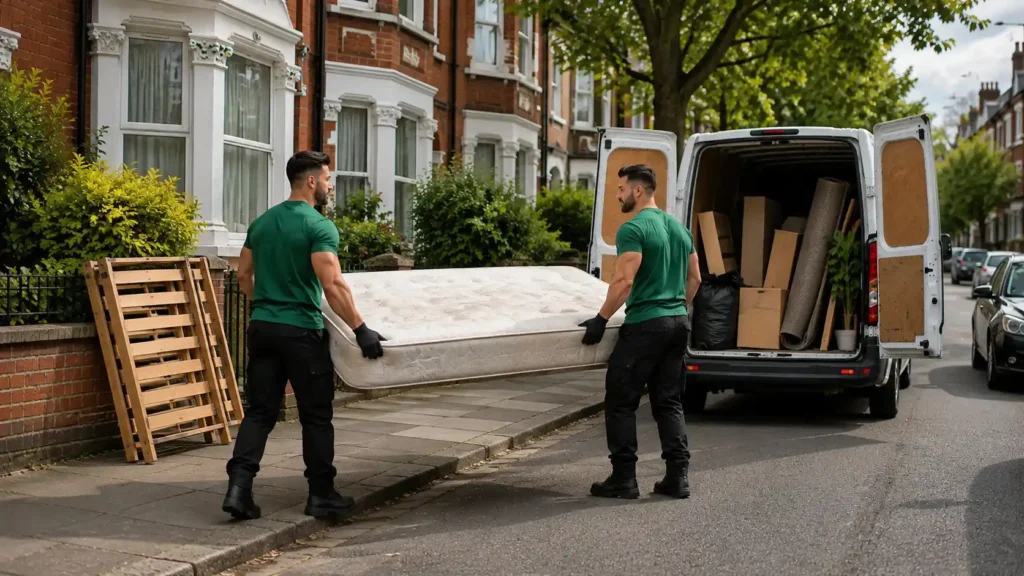
Getting rid of an old mattress can be surprisingly difficult. It is too large for a normal household bin, awkward to carry and should not simply be left outside a property or beside communal bins.
For residents in Ealing, there are several responsible ways to dispose of an unwanted mattress, including council bulky waste collection, taking it to a reuse and recycling centre, arranging retailer take-back or using a licensed private waste carrier.
Choosing the right option depends on the condition of the mattress, how quickly it needs to be removed and whether the household can transport it independently.
What Is the Best Way to Dispose of a Mattress in Ealing?
The most appropriate disposal method will normally depend on whether the mattress is still usable.
If it remains clean and in reasonable condition, reuse should be considered before disposal. An unwanted mattress may potentially be offered to someone else, donated where accepted or passed through a suitable reuse scheme.
If it is damaged, heavily worn or no longer suitable for use, residents can consider:
- Ealing Council’s bulky waste collection service
- Greenford Road reuse and recycling centre
- A retailer mattress take-back service
- A licensed private rubbish removal company
Ealing Council specifically advises residents to consider giving usable bulky items to others before arranging disposal.
Can Ealing Council Collect an Old Mattress?
Yes. Ealing Council’s bulky waste collection service accepts mattresses as part of its collection service for large household items.
The council currently charges £30 for up to six items. A mattress and a separate bed base are treated as two items when both are being collected.
This can be a practical option for residents who are able to move the mattress to the required collection point and do not need immediate removal.
Council guidance states that items need to be accessible at the front of the property. On the collection day, booked items should normally be placed at pavement level inside the property’s boundary rather than directly on the public pavement.
Residents should only put out the items included in their booking.
Are All Mattresses Accepted for Council Collection?
There is an important exception.
Ealing Council states that items which have been in contact with mould or a pest infestation are not accepted through its bulky waste collection service because they may present a health risk to collection teams.
Anyone disposing of a contaminated mattress should therefore check the appropriate disposal method before arranging collection.
Can a Mattress Be Taken to Greenford Recycling Centre?
Another option is the Greenford Road reuse and recycling centre, located at Greenford Road, Greenford, Middlesex UB6 9AP.
The centre accepts mattresses, although residents need to book a time slot before visiting. Residents arriving without an advance booking are not permitted to enter.
Ealing Council’s current rules state that residents can dispose of up to two mattresses free every 12 months at the Greenford Road centre.
More than two mattresses at a time, or exceeding the stated annual allowance, may be treated as trade waste and charged accordingly.
Taking a mattress to the recycling centre can therefore be economical for someone who has access to a suitable vehicle and can safely load and transport the mattress.
For many households, however, transportation is the difficult part. Mattresses are bulky, flexible and often difficult to fit safely into an ordinary car.
Can a Private Rubbish Removal Company Collect a Mattress?
Yes. A private collection service can be useful when a mattress needs to be removed directly from a house, flat, rental property or other location.
Residents who do not have a vehicle or who would prefer not to lift and transport a bulky mattress themselves can arrange rubbish removal in Ealing for unwanted mattresses, furniture and other household rubbish.
A professional collection can be particularly convenient when:
- The mattress is difficult to carry
- The property is a flat or apartment
- Several bulky items need removing
- A bed frame is also being disposed of
- A property is being cleared
- A tenant is moving out
- Rubbish needs collecting quickly
Private waste removal may also allow several different unwanted household items to be collected during the same visit rather than arranging separate disposal trips.
Why Is Using a Licensed Waste Carrier Important?
Residents should not simply choose someone offering cheap waste collection without checking who will ultimately be responsible for the rubbish.
Householders in England have a legal waste duty of care. Government guidance says householders must take reasonable measures to ensure their waste is transferred only to an authorised person.
When using a private rubbish clearance business, residents should check that the business has an appropriate waste carrier registration.
The Environment Agency maintains a public register that can be used to verify whether a waste carrier, broker or dealer is registered.
Keeping a receipt or other collection information can also provide evidence that reasonable checks were made if waste subsequently ends up being fly-tipped. Government guidance recommends keeping details such as the carrier’s registration information, receipt or vehicle information where appropriate.
Why Shouldn’t a Mattress Be Left Beside the Bin?
A mattress should not simply be placed beside normal household bins in the hope that it will be collected.
Ealing Council states that excess rubbish, furniture and other large items should not be put inside or next to normal rubbish bins. Residents should instead use an appropriate bulky waste collection or take suitable items to a reuse and recycling centre.
Leaving a mattress on a pavement, beside communal bins or elsewhere without an authorised collection may also create an obstruction and could potentially be treated as fly-tipping.
The safest approach is to arrange the disposal route before moving the mattress outside.
Can an Old Mattress Be Donated?
Sometimes, but condition matters considerably.
A mattress that is clean, structurally sound and still usable may have more options than one that is stained, torn, damp or heavily worn.
Possible reuse routes may include:
- Giving it to someone who needs it
- Offering it through a local community group
- Using an online reuse platform
- Checking whether a local charity accepts mattresses
- Asking whether the new mattress retailer offers a take-back service
Not every charity or reuse organisation accepts mattresses, particularly because of hygiene, condition and fire-safety requirements. Acceptance should therefore always be confirmed before transporting one.
Ealing Council also suggests reuse options, online communities and retailer take-back schemes as alternatives for suitable bulky items.
Does a Mattress Retailer Take the Old Mattress Away?
Some mattress retailers offer collection or recycling services when delivering a replacement mattress.
The service may be included with delivery or available for an additional charge, depending on the retailer.
Anyone purchasing a new mattress should check the retailer’s removal options before arranging another collection. This can avoid paying for two separate services and means the old mattress can often be removed when the replacement arrives.
Residents should also check whether the retailer requires the old mattress to be wrapped or moved to a particular location before collection.
How Should a Mattress Be Prepared for Collection?
Preparation depends on the collection provider, so customers should always follow the instructions given when booking.
A few practical steps can make removal easier:
Clear the Route
Remove small furniture, boxes and other obstacles between the mattress and the exit.
Tell the Collector About Stairs
If the mattress is upstairs, in a basement or inside a flat without a lift, this should be mentioned when requesting a quote.
Mention the Mattress Size
Single, double, king-size and super-king mattresses can have very different handling requirements.
Explain Any Access Restrictions
Narrow staircases, limited parking, controlled entrances and long walking distances from the property to the vehicle can affect a collection.
Do Not Leave It Outside Too Early
Unless instructed otherwise, a mattress should remain protected until the agreed collection arrangements are clear. Leaving it exposed to rain can make it heavier and more difficult to handle.
What About Mattresses From Flats in Ealing?
Mattress disposal can be particularly challenging for people living in flats.
Residents may need to consider:
- Narrow communal staircases
- Lifts that are too small for a mattress
- Parking restrictions
- Distance between the building and collection vehicle
- Building management rules
- Communal entrance access
Before arranging collection, providing accurate access information can help the clearance team determine how the mattress can be removed safely.
People living in managed blocks should also avoid leaving mattresses in communal corridors, entrances or bin stores unless this has specifically been authorised.
What Is the Most Convenient Mattress Disposal Option?
There is no single solution that suits every household.
| Disposal method | Best suited to | Main consideration |
| Council bulky collection | Residents who can prepare the item for scheduled collection | Collection rules and available dates |
| Greenford recycling centre | Residents with suitable transport | Mattress must be transported personally |
| Reuse or donation | Clean mattresses in usable condition | Acceptance varies |
| Retailer take-back | People buying a replacement mattress | Usually linked to a new purchase |
| Private rubbish removal | Households wanting collection and loading | Check waste carrier credentials |
Residents should compare convenience, cost, timing and the amount of lifting required before choosing.
How Can Mattress Disposal Be More Environmentally Responsible?
Responsible mattress disposal involves more than simply getting the item out of the property.
Where possible, the priority should be to keep usable products in use for longer. If reuse is not practical, using an authorised disposal route helps ensure the mattress enters an appropriate waste-management system.
A responsible approach includes:
- Checking whether the mattress can genuinely be reused.
- Considering retailer take-back when buying a replacement.
- Using a council or authorised recycling facility.
- Checking a private collector’s waste carrier registration.
- Avoiding unlicensed collectors and fly-tipping.
- Keeping collection details or receipts where appropriate.
These steps help residents dispose of bulky waste without creating unnecessary environmental or legal problems.
Final Thoughts
Disposing of a mattress in Ealing does not have to mean leaving it beside the bins or struggling to fit it into a car.
Residents can use Ealing Council’s bulky waste service, take eligible mattresses to Greenford Road reuse and recycling centre, explore reuse or retailer take-back options, or arrange collection through a registered private waste carrier.
The best choice depends on the mattress’s condition, transport availability, access to the property and how quickly it needs to be removed. Whichever route is chosen, checking that the mattress is passed to an authorised collector or facility is an important part of responsible waste disposal.